
Cuteness is a worldwide phenomenon. From Labubu blind boxes to Hello Kitty Swarovski, cuteness is not only geeky or childish, but extremely hip and happening. High fashion brands have started to collaborate with cute brands and fashionistas embrace character mascots, like Labubu. Gen Z has embraced kawaii culture, but so have many other segments. While it used to be pretty nerdy to have a lot of manga and cute styling in your house, it’s now become accepted and even celebrated.
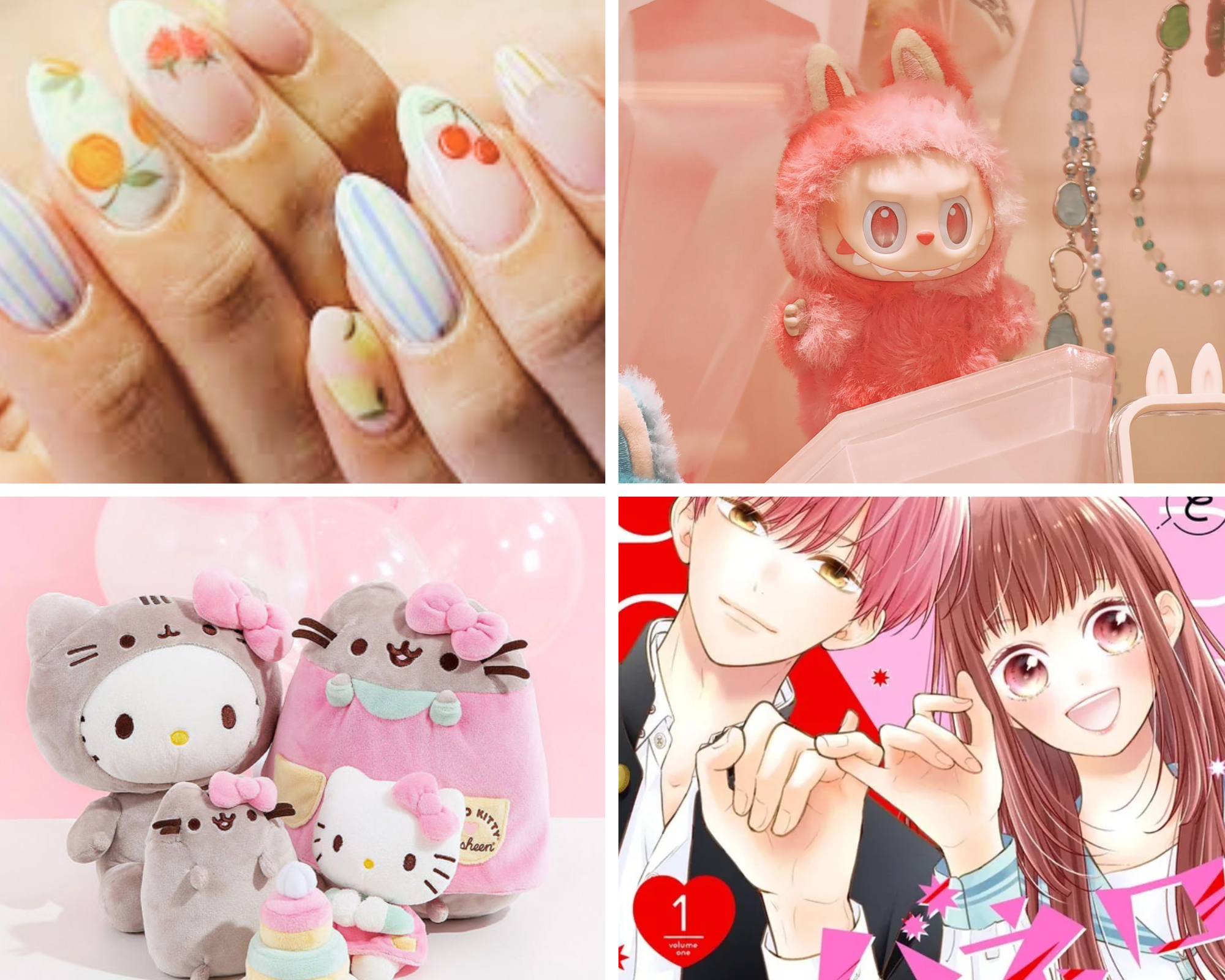
Cute isn’t just plastic toys anymore – it’s glittery colorful nail polish, it’s colorful clothing and it’s character ornaments. It’s Stitch keychains, blind boxes and gachapon balls. It’s digital VR cat girl-avatar and Hello Kitty cookies. Cute has become bling. Something we fashion ourselves with and wear with a performative function. It’s a lifestyle.
After seeing the exhibition Cute in Kunsthal Rotterdam, I wanted to take a moment to unpack cute lifestyles, and how they sell.
On Cuteness
Cuteness has a long-lasting visual appeal. It’s adorable, appealing, feminine-coded. It’s meant to raise emotions, a physical response that makes us go “ah, that’s adorable!” From kitten memes to wide-eyed emotions, cuteness is to an extent universal. What’s cute is sweet, vulnerable, and in need of protection. In her essay The Cuteness of the Avant‐Garde, Sianne Ngai writes that cute is “soft, round, and deeply associated with the infantile and feminine” (814).
Cuteness has biological meaning, as many psychologists have focused on. What is small, infantile and has big eyes needs to be protected. This has even been called the baby schema by Konrad Lorenz (1971), which is a concept still applied to understand the evolutionary function of cuteness. What I find interesting, however, is seeing how the cute circulates across media. How is it sold? How do different tropes start to blend in global manga, Popmart character merchandise or fandom?
In our global media culture, cuteness can take on many forms. For example, it can be retro. Think of indie games with pixel art, generation one Pokémon or Miffy. These styles and characters have decades of history by now, and with the lightning speed of media production today, that’s a considerable time span. Cuteness can therefore raise different affects, including nostalgia. It can also overlap with new categories and styles, such as cottage core which flourished during the pandemic. Or cozy fiction, with its warm qualities, and tropes like coffee bars and gardening. Cuteness is manifold and not one genre, but it’s highly visible in our popular culture if we look for it.
In our ultra-fast, global, hyperconnected world, cuteness becomes an antidote. It asks us to slow down. It appreciates what’s girly, warm, fun, seemingly childish and nostalgic. Cuteness celebrates innocence, in a time when mental illness and anxiety is on the rise. It might seem simple, and even like an escape from reality, but we need it. Cuteness provides comfort.
Still, cuteness also reflects these cultural anxieties. What’s cute can also be creepy, like the toothy Labubu. The line is thin between cute and other expressions – the kitsch and the cheap, the monstrous, the eerie, the weird, the gothic, the Other. The art of Mark Ryden, Tim Burton and Takashi Murakami are some strong examples of this. Cuteness can be weird and dark. For instance, I recently published an extensive study about The Nightmare Before Christmas and its cute, gothic merchandise and fashion lines. The lines between the gothic and the cute were very thin in these consumer goods.
In The Power of Cute, Simon May emphasizes how the cute is often ambiguous, unsettling and artful. It takes command of us. We want to protect it, collect it, consume it and adore it. But as consumers, we are anything but stupid. Most adult collectors and tweens understand that this is part hype, part indulgence – a small escape or joy in an otherwise very complicated world.
The history of cuteness is not singular, but runs across the development of art and cultural artefacts, from European porcelain dolls (e.g. bisque dolls) to manga and the Dutch Miffy. As Kumiko Sato writes, in Japan it’s deeply related to postwar culture. It’s interwoven with material and visual culture, graphic design, animation and comics. These different histories did not always relate, but came together as popular culture became more global and shared, partly due to the internet.
What is striking is that historically, cuteness often runs parallel to crisis. For example, Sato writes about the Japanese context: ‘A new wave of kawaii arrived with the protracted economic crisis. The Hello Kitty revival happened in the mid-90s when the value of the Japanese yen fell drastically and major Japanese banks went bankrupt.’
Perhaps we see a similar turn towards the cute right now, in a period of global political tensions, the climate crisis, economic recessions and housing crises. The chips are down, but cute visual and merchandise can grant us some comfort.
Dressed up in Kawaii
And that brings me to Labubu and ita bags covered with merchandise. Cuteness can also be kitsch and bling. We love to wear it to make us feel good. It brings a positive spirit to our clothing, our style and our bodies. Like cosplay, it helps us form an identity through popular culture.
This kawaii drip can take on many forms, from key chains to dolled up eyes and gothic Lolita styles. Kawaii bling can be seen everywhere in the mundane items – a phone sleeve, a box of eye lashes, shoe laces. It can be extreme, like the shoes of Irregular Choice. I am not surprised that I suddenly find tamagotchis everywhere in The Netherlands making a comeback. Not only are they adorable keychains, we pair them with taking care of a retro digital pet. Ideal!
Cuteness and popular culture are now adopted by high fashion brands as well, a phenomenon that fascinates me endlessly. While these products on surface level seem to target fans and collectors, most consumers cannot even afford them, nor are they readily available due to their scarcity. I recently wrote about Star Wars luxury fashion, where dresses were marketed in connection to fandom, but not for fandom per se.
We see something similar happening with cuteness now. As these tropes went mainstream, they became appropriated by different brands and consumers beyond their subcultures. Popmart is an endless success story of this. This brand now draws huge cutes, consisting not just of enthusiastic consumers, but fashionistas, influencers and scalpers. One can wonder how invested some of these groups really are in Crybaby, Skull Panda, Labubu, Disney and the other licenses of Popmart. Their Labubu merch gained immense resale value, while fakes (“Lafufus”) float the market as well and dupe consumers.
This is a market where blind boxes are common, which adds an element of surprise and scarcity. You never know which character (version) you’ll exactly get. Still, these also leads to an active market of trading, swapping and reselling. And you also have to look hard into whether you have a real item or a bootlegged one. Believe me, I recently got three fakes in a short time span from enthusiastic friends, each of them excited to hook me up with a real Labubu.
In other words, cuteness is not just a style, but a complex economy. It includes authentic products, high and low-end consumer brands, an active fan market and a shadow market of bootlegging, thrifting and vintage. Cuteness as a business model is not that separate from the fan economies and character cultures that I described before. However, while I normally study adult fan markets, what I find fascinating about cuteness is that this now spans generations. This is no longer a market of teddy bears for children and a few products for older generations, but a market for the mainstream. While kawaii culture was already visible in Asia for a while, it’s now penetrating the West. Miniso, Popmart and other companies are happily capitalizing on this. And good for them, really! I
Cuteness is often seen in contrast with the serious qualities of life, like our work life, politics, taking charge, and yes, adulthood. I think that’s true, but it’s also deeply rooted in capitalism, and a critique of that system. We buy useless, cute things to energize the market, while we at the same time know we are being played. We buy them to “save them” and because we like having these companions around. We buy cuteness to find comfort. We buy it to question what’s normal and to show how we are different ourselves. We buy cute things in difficult times and in moments of crisis.
Of course there is a flip side here. Overconsumption, hypes, shadow markets – these are the effects of the cute going fully mainstream. You are right to question the sustainability of rapid cute merch, or to worry about cuteness overshadowing certain messages. Japanese scholars in the past often frowned upon Cool Japan, a project driven by the government to make Japan seem hip through manga. However, it also read as a form of soft power and light propaganda. It’s hard not to look at Labubu and feel similar.
Cuteness is a sign of our modern times. However, it’s firmly embedded in capitalism and consumption. Is that a problem? To an extent, yes. But I do want to stress that those that sincerely care about cute products treat them with great care, love and not as disposable or cheap at all. To the fans, buying Labubu is an act of affect and, ironically, difference. The Labubu, even though many have them, sets them apart. It can even be dressed up and customized further. This culture is not about hoarding, it’s about caring.
While collecting cute merch might not seem that sustainable, I do think these products are treated with great love, as opposed to, say, the rapid cycles and waste in fast fashion. While it’s important to stay critical, I don’t think all sustainable issues can be pinned on consumers. Brands, governments and other stakeholders need to change there, and it’s important that we can still enjoy art, culture and designs. And yes, that includes toys if you ask me.
The overconsumption of Labubu, to an extent, might even be read as a critique of capitalism. We want to stand out with unique (blind boxed) products in a time where mass consumption is at a peak. A complex matter for sure! Regardless, my general advice would be to buy consciously and treat your beloved products with care. To those that love the cute, I want to say please honor it and wear it like a badge of pride.
References
Lorenz, Konrad (1971). Studies in Animal and Human Behavior. Cambridge, MA: Harvard Univ Press.
May, Simon (2019), The Power of Cute, Princeton, NJ: Princeton University Press.
Ngai, Sianne (2005). “The Cuteness of the Avant‐Garde.” Critical Inquiry 31.4: 811–847. CrossRef. Web. 2 Mar. 2013.
 Nicolle Lamerichs