
As a researcher, I’m always excited to talk about my favorite theories and methods. In fact, one of my passions is sharing information about virtual ethnography! It’s a method that I have often used to study a wide range of consumers and artists, whether they are hardcore fans, gamers, tourists or content creators. I love that ethnography allows me to be in direct conversation with a community, while also drawing from resources that are already out there.
Ethnography takes place in many different fields, often across a time span of months or years. In my research, I have compared different countries, cultures and expressions. Offline, I attend events, visit conventions, go to theme parks and stores. I use these as moments for observation, reflection and participation. I talk to people briefly, store my information, and keep reflecting. When information is missing, I go out into these fields again and again. Ethnography is iterative, and it allows me revisit my data or field when part of the narrative is missing.
Online, ethnographic methods can also be used to explore different communities and platforms. Through virtual ethnography (also known as digital ethnography), I meet different users. Each platform is different and I constantly have to adapt my methods to deal with different types of material. While Reddit data can be easily stored and retrieved, a researcher might need to think twice when dealing with TikTok or Twitch observations, where content might disappear after a certain amount of time. Or simply is not that easy to find again.
However, the internet is a far from stable place today. This meant that I often had to revise my approach . I want to share insights on doing ethnography in a highly data-driven media culture.
Dealing with Data and Internet as an Everyday Practice
Virtual ethnography was founded about two decades ago, when the internet was presented as an almost magical place. Social media were in their early phases and a lot of information was provided in forms. This meant that platforms were:
- Highly searchable and less determined by liveness
- Largely free from algorithms
- Driven by the content from your followers or your own keywords
It was a great time to be online. You could even reach the end of your feed!
The popular digital ethnography handbooks that we use today, for instance by Robert Kozinets, Cristine Hine and Annette Markham, were written for these type of communities. While these handbooks are still very useful and I highly recommend them, it is also important to be mindful of what changed.
As I wrote before, the internet changed considerably the past years and this poses immense challenges for users, creators, critics and scholars. Today internet communities for instance have no stable dynamics. The community that one person sees, is quite different from what another sees. This has everything to do with algorithms.
Most current platforms are dominated by algorithms which provide us an endless stream of content and determine what content we see. Even when we are part of big communities on Facebook, this content might not necessarily reach us. We live in an era of Big Tech and filter bubbles.
Ask yourself this. Is there even an Instagram community that you interact with on a daily basis? Or are you just interacting with content creators? How do you value the community experience on Reddit or Facebook?
Virtual community, then, is a contested term. Where do they exist, if at all? In fact, the internet is deeply ingrained with everyday communities by now, like our work life, study and hobbies. Since Covid-19, our work life has been largely determined by tools such as MS Teams, Zoom and (rest in peace) Skype. A typical classroom setting blends with tools like Blackboard, Canvas, MS Teams, Whatsapp and so much more.
Perhaps virtual ethnography at some point turns into regular ethnography, as the internet becomes as normal as electricity. However, we also see that some companies try to pivot to the next step in the internet experience, which they also describe as the metaverse.

Approaches to Virtual Worlds and Economies
Dealing with complex virtual worlds can be challenging but worthwhile. While these worlds take some time to familiarize one self with, their communities are often highly invested and fantastic to be a part of for a longer time. Whether you join a guilt, start trading, or build a beautiful avatar on VR Chat, you will get new experiences and meet others. That’s fun! But it can also be overwhelming. Luckily, I have a few tips:
- Be open about who you are
- Join communities that are accepting of researchers
- Keep things in perspective, there are many different sub-communities in virtual worlds. Your experiences are not the default, so keep checking, interviewing other members and observing how they view the platform
- Take care of yourself as well in these worlds. While some communities are very positive, others can be full of trolling and negative behavior which will impact you
In the study of these immersive environments, such as VR Chat and Fortnite, ethnographies of earlier virtual worlds are still highly applicable. I highly recommend the work of Celia Pearce, Tom Boelstorff and TL Taylor who provide ethnographic insights on complex virtual worlds and economies. While interfaces and graphics might change, many of the cultural dynamics that they describe still hold up.
Overall, I love also popping into different platforms for unique experiences that relate to topics that I study. Ariana Grande’s Rift Tour? Sign me up! A virtual idol concert on VR Chat? I might just log in to see what that’s like.
I do see ethnography moving into his direction. Some users make a whole career out of virtual worlds as virtual idols, content creators or fashion designers. It will be interesting to see how these cultures develop the coming years, and where they intersect with daily practices.

Dealing with AI, Bots and Artificial Content
Artificial communities and data pose new challenges for existing research methodologies. The latest ethical guidelines of AIoR also focus on artificial intelligence, scraping and other ethical domains of internet research. Social media posts are increasingly automated, and different automated artworks blend seamlessly with human art and content. This requires an adaptive approach to virtual ethnography.
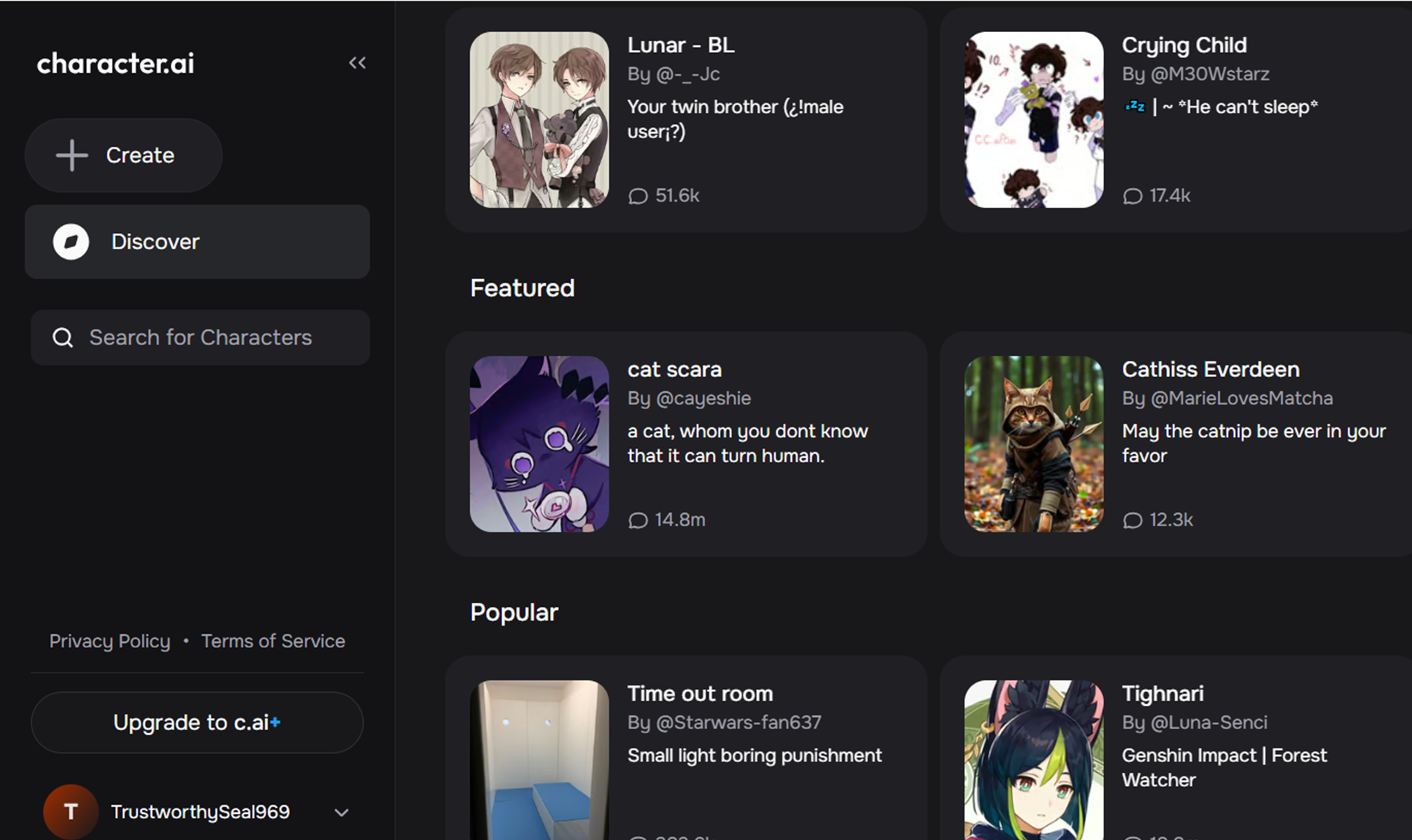
Think of how people increasingly communicate with chatbots. These conversational partners are used in marketing, helpdesks but also increasingly as companions. I have for instance done a small-scale ethnography of Character.ai, and expect to do more of this type of work in the future. Character.ai contains a wealth of character bots that users can interact with, such as therapy bots, language coaches and anime characters.
Can bots and artificial content be studied through an ethnographic lens? It is interesting to consider a posthuman turn in digital ethnography. The past decades, internet research, and virtual ethnography more specifically, have had a heavy focus on human users. However, we increasingly deal with generated content without a clear creator or user behind it. This also makes character.ai an interesting space to study.
At the moment, I am applying ethnographic methods to this community, while being mindful of the restrictions. What I recommend when dealing with artificial content and bots:
- Store prompts and notable conversations are tracked in an excel sheet or doc
- Take screenshots of what stands out
- Write observations and close-readings in a research diary, while also reflecting on the nature of this artificial data and the conversations
- Involve the wider human community. For instance, in the case of character.ai, what information can be gathered from forums and other resources? Can users or fans of this latform be interviewed?
- Consider auto-ethnographic stances as well. Create your own bots or automated works. What happens when you reflect on this process?
Research on generative AI, which is a contested issue, must be done in a responsible way. I encourage ethnographers specifically to treat these tools with sensitivity and critical context. It helps to treat them as part of a social and cultural development, where a social constructivist framework can provide necessary insights.
I would argue that in any posthuman ethnography, the human subject needs to be accounted for. Try to create a dialogue that doesn’t just involve bots, or self-reflection, but narrates the experiences of other users. How do users reflect on the role of generative AI in their daily life? How do they treat these tools in their interactions? What do they get from interaction with character bots?
Doing observations in real life of how people use bots is a great way to approach this topic, which also means that the ethnography could be paired with interface or design studies.
To be sure, I’m not speaking here of doing ethnography supported by AI tools, which I personally have no experience in and have reservations about. However, if you look for more information on automating your ethnography, a starting point could be Automated Digital Ethnography, as described by Azimuth Labs.
The New Ethnography
The coming years, we will see the emergence of new types of digital ethnographies, and perhaps new digital methods altogether. These are the result of the following challenges:
- Artificial content and communities
- Intersections of the human and posthuman
- The diversity of media content and experiences within digital platforms
- The way communities are structured and divided today by algorithms and hashtags
- The spectrum of the internet and daily life, which are not separate but extend each other
I hope this read will help you and inspire you as you create your own ethnographies yourself. Do you need help? Remember that I’m just a step away in this rich culture that we call the internet. You can always drop me a line or two.
 Nicolle Lamerichs