
Sea of Stars is a beautiful indie J-RPG, driven by genuine affect and worldbuilding. With the theme of friendship at its core, the game explores personal relationships, and also what happens when these fall apart. It is an example of how games can represent, and even simulate, complex emotions. In doing so, the game joins a long line-up of emotional, artistic games. Think of the role of grief in Gris, romance in Final Fantasy 8 and loneliness in Shadow of the Colossus.
Sea of Stars dives deep into friendship, but also grief, sadness and closure. It’s a game that I thoroughly enjoyed this year and have many thoughts about. Let’s explore its key themes! How does Sea of Stars represent friendship? How does this tie in with other themes, emotions and interpretations of the game? How do its mechanics and game play contribute to these ideas?
Please note that this article contains spoilers for Sea of Stars

About Sea of Stars
The story of Sea of Stars is a classic fight of good against evil. Our main characters are Solstice Warriors, equipped with the powers of the sun and moon, who have to defeat The Fleshmancer and their creations. This ancient evil has been around for generations, and as we find out later in the game, across many different worlds.
Sea of Stars begins with the new trainees of the Solstice order, Valere and Zale, and their friend Garl, who is a regular human. Garl is a good-hearted character, and a cook, who loves to fight with the others. However, it becomes clear early on that he is especially vulnerable. The game starts when they are kids, and Garl gets hurt in a fight and looses his eye. Much later, they meet Garl again and start travelling together to face the forces of evil.
Much like Chrono Trigger, Sea of Stars features diverse playable characters, including non-humans. Players get to meet lovable stone giants, dragons, moles and many other anthropomorphic characters. Eventually it turns out that many of the events, and the struggle between good and evil, results from the fight between two immortal beings – Resh’an (The Archivist) and Aephorul (The Fleshmancer). Countless worlds have already been destroyed by The Fleshmancer, with only the Solstice Warriors standing in his way. The game ends with the party saving one world, but what’s next?
Friendship and Vulnerability
Sea of Stars presents a colorful and quirky world at first sight, but it becomes clear that this world is more complex than it seems. The evil creations of The Fleshmancer are difficult to stop, and parallel realities reveal themselves that also require saving.
Vulnerability is a key theme. Zale and Valere, as Solstice Warriors, have exceptional powers while regular humans, such as Garl, are vulnerable. Garl is eager to protect his friends, but often gets into trouble as a result of this. Personally, I was really moved by this, because Garl is a likeable character and easily my favorite in the game. Garl has a sense of loyalty and persistence. He tries to help, even when that puts him in danger in fights.
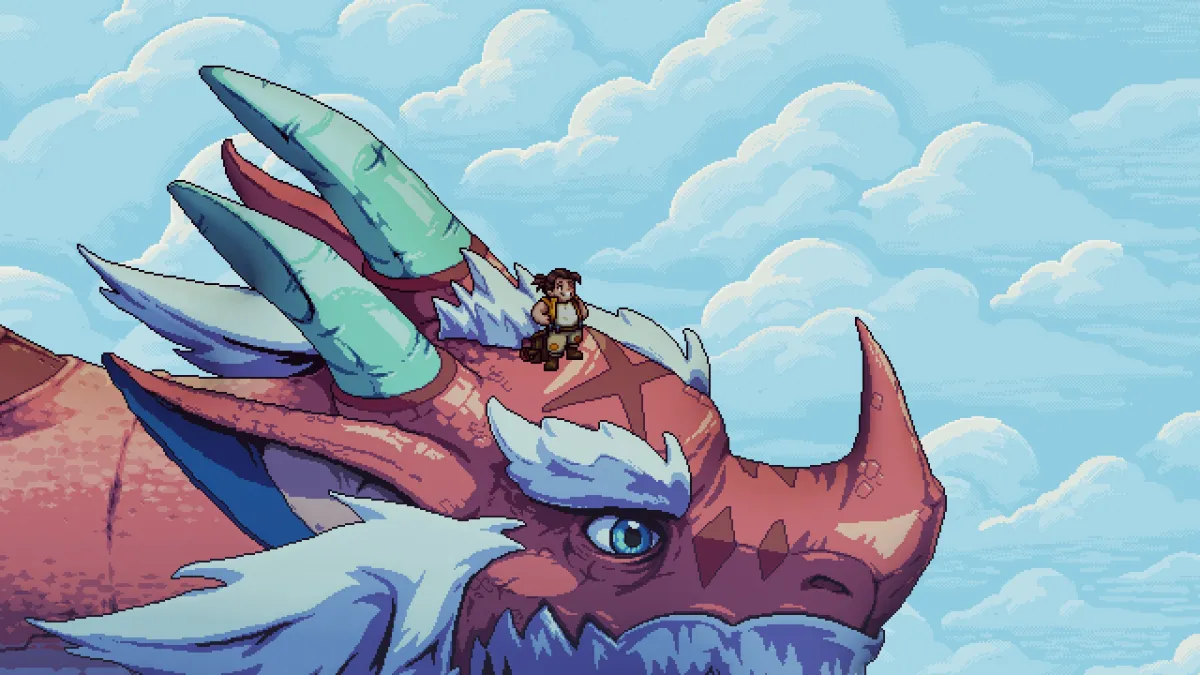
Garl gets severely hurt three times in the game, once as a kid, once by a curse, and once by The Fleshmancer. During that last event, Garl jumps in front of his friends to save them, which builds up to his death. With a flash of borrowed time, he is still able to help his friends one last time. With his cooking skills, Garl awakens the large dragon around the island before he eventually passes away. After these events, the game gets gradually darker as his friends miss him and traverse worlds.
Sea of Stars is a testament to the friendship between Zale, Valere and Garl. Even when Garl has passed away, his spirit lingers in the game play. Early in the game, Garl teaches his friends how to cook, which is the key mechanic to heal in this game. As the “warrior cook”, he is essential in keeping his friends alive. Cooking is fundamental to the game, and reminds players of this friendship often.

Just an Ordinary Guy
Garl is just a guy, and that is exactly what makes him so special. A lot of players are enthusiastic about Garl, for instance on this Reddit thread. He’s a regular human has such purpose and determination. He keeps going even though he has no obvious powers. One user writes: ‘The world needs more Garls – someone who is brave and faces adversity with a smile and optimism.’
Garl stands for bravery, purpose, mortality and vulnerability. He is like us and believes in people, which makes him inspiring. He is proactive, when the Solstice Warriors are not. He stands in stark contrast with them. They are born with special powers, and chosen, but also passive as a result. It’s Garl who thinks of how to help people, communities, and often takes lead. For instance, he restores and names a village, reawakens a dragon with a complex cooking scheme, and provides people with second chances.
However, Garl also has a lot of haters. For one, he’s always positive. That upsets people, but is true to Garl’s spirit and what he needs to survive. As a regular guy, he can sometimes read as a Mary Sue, who does not fit the universe and steals the show from other characters. One user on Reddit writes: ‘The game just told us constantly that he’s the best guy ever and we NEEDED to care about him but he himself is a pretty shallow character.’ The writing, some players argue, does not always work because the game explains and emphasizes continuously how great Garl is. I do agree with this criticism -the game could have been more show, less tell.
A video essay on Garl by Genesis links the character to empathy. Garl is a positive character, who wears his heart on his sleeve. Many players love him for that. However, I think that’s also the reason why others hate him. Emotions and emotional characters are often looked down upon. There is a lot of bias towards emotion, especially when it’s linked to masculinity. This could be one of the reason why some, even if it’s unconscious, may not like Garl. Emotional intelligence is a superpower, by out society doesn’t see it like that.
In other words, an ordinary human is the real hero in this game, which can read as empowering to some, and as frustrating to others. However, Garl is a character that thrives in the interactions with the others. I would say that this game is all about the party being the heroes. There are three main characters, and they add to each other. The interaction between Zale, Valere and Garl, in particular, is the most important in this game. This game represents community and collaboration. Real heroes work together.
Struggles and Dark Friendships
There is another important friendship in this game, the one between Resh’an (The Archivist) and Aephorul (The Fleshmancer). While we know little about these characters early in the game, it is revealed mid-way that they used to be close friends. These two immortal beings darken the theme of friendship considerably.
The Sea of Stars wiki describes their background well: ‘Resh’an was a powerful alchemist who set out to create the Elixir of Life, along with another alchemist known as Aephorul. The two succeeded and gained immortality, but at a price, as their bodies decayed and became disfigured, which they hid underneath their robes. The two spent centuries nurturing the world. But eventually, Aephorul became embittered and began cursing the world with his monstrous creations created through forbidden schools of alchemy. He embraced the title of The Fleshmancer.’ As The Fleshmancer grew stronger, Resh’an eventually broke the world into countless of alternative realities. Their relationship grows ever more complex, even during the game.
A defining moment in the game is when Resh’an discovers that an old birthday gift from Aephorul was obtained through vile acts. The gift was Resh’an’s great eagle form, given to him when they were still friends. This form is his special skill in the game and an important element in the plot and the combat. This event makes it clear to Resh’an that he was still friends with Aephorul when he already was evil. Resh’an had completely misjudged him for years. Moreover, The Archivist has to reckon with the fact that his special powers were created through evil actions. This is hard to bear for Resh’an, who at that point leaves the party.
The complex relationship between these two characters, one good and one evil, is fundamental to the game. It reminds me of Xavier and Magneto, two characters who had a profound friendship and perhaps romance, who drifted apart. In the true ending, Resh’an returns and takes his friend to a new world, mending their relationship.
Overall, Sea of Stars emphasizes the power of friendship. These relationships are important and last a lifetime. They can be more meaningful and long-lasting than many of our romantic relationships, but are not always viewed as such. Sea of Stars makes us see friendship from different angles, embedded in the game play, the world and even the symbolism of the story. While many J-RPG’s touch upon friendship, it’s hard to think of one that is more layered in this approach. I cannot wait to see if the Sea of Stars DLC will continue this theme.

Read more game theories here:
Dear Esther | The Last Guardian | Deltarune | Night in the Woods | Oxenfree | Abzu | To The Moon | Contrast | Thomas was Alone | Final Fantasy VII R | Final Fantasy VIII | Death Stranding | Stanley Parable | GRIS | The Witness | Monkey Island
 Nicolle Lamerichs