
Remix increasingly characters our media landscape. Generative AI, for example, has sparked a revolution in how users create content but augments existing styles, tropes and biases. Similarly, transmedia storytelling has peaked this year. From Wonka to Wish, franchises are a common business model, relying on existing content, remix and self-referentiality. There is also critique of this nostalgia industry in which old favorites reappear again and again in a slightly different form. What are the new stories in which consumers can find meaning, authenticity and inspiration?
Franchising Characters
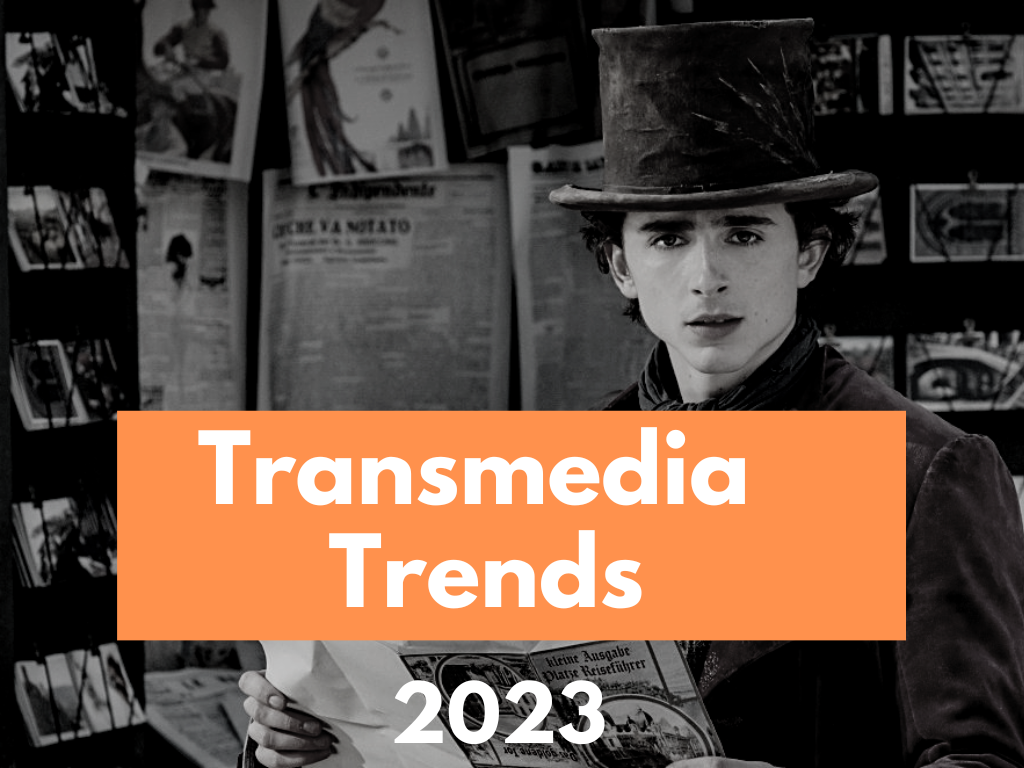
Transmedia storytelling and worldbuilding has turned into a lively business model the past years. It is nothing new that that companies use existing stories as a source-text for sequels or prequels. However, today they increasingly take characters as a starting point, rather than worlds or stories. These characters are the real selling point for the industry, since they are liked and loved by fans across the globe. Think of Loki’s second season, which explores the character from different angles in the multiverse. Wonka is another example as it provides a magical backstory for the famous capitalist chocolatier.
While these productions are well-made, some fans also increasingly critique this nostalgia industry for its consistent remixing of existing stories, often without much consideration and critique. These stories are not fresh anymore, nor do they have the same impact today, taking from their original context and time. These concerns are perhaps most visible in Wish, the lowest rated Disney film in two decades. Wish is a transmedia take on Disney films, but one that reveals the worst side of this production style. The film is formulaic, poorly paced and self-referential in obtrusive ways. Every single Disney film gets a reference, but rather than a celebration, it quickly becomes a distraction. Wish reveals what can go wrong with transmedia – an easy reliance on existing content and tropes without any innovation.
Indiana Jones, Scott Pilgrim, Ahsoka and many others passed our path again in 2023. Many consumers wonder at this point, has the time come to tell new stories?

Inspiration and Enchantment
What consumers want from media today is to be immersed in something else, something different. Familiar characters can be reassuring, but there is also a need for immersion in new and magical places. Brands can revolutionize this space, by being uplifting, inspiring awe, and flipping the conversation, as Wunderman Thompson agency describes in The Age of Re-Enchantment. Media can enchant consumers and uplift them in dark times.
The revival of Dungeons and Dragons, for instance, shows that consumers want to be immersed in long-format storytelling. They want to tell stories that are personal, curated, and create their own characters. These original characters are increasingly popular in fandom in general, where fans roleplay them online, create art based on them and develop them further in fiction. They also show a need for new and refreshing characters, rather than familiar favorites that saturate our media landscape.
These immersive experiences are also sought in other ways. Think of the large digital spaces like Fortnite, long-form podcasts but also of sensory media that appeal to our sound and fragrances. Tactile hardware falls under this, but also ASMR and Lo-Fi YouTube channels aimed at deep focus and relaxation.
While short-format and TikTok is still very popular with Generation Z, there is also a need for deeper and richer content. A good example of this is the 4 hour long video essay of YouTuber HBomberGuy who cleverly examines plagiarism in the creator economy. In a catchy Ace Attorney style, several painful cases of plagiarism are discussed, and how creators got away with it. This deep investigation made the rounds in many communities, from journalists to bloggers and gamers. Many found out that their work was plagiarized by a notorious YouTuber. The critical video has drawn over 10 million views.
This video is not an exception. Consumers are highly engaged by long-format video essays and use platforms such as YouTube as a tool for criticism and education. Moreover, YouTube can still give influencers a stage for critical and social intervention.
Democratization of AI
Generative AI is here to stay. Through tools such as Chat GPT and Midjourney, users have been able to experiment with content generation. While generative AI has become democratized, there is also increased critique of how it is regulated. Content is turned into training data without permission of users.
Despite these critiques, some tools are popular within fan spaces, because they extend the fan experience and do not compete with existing art. The rise of character.ai is a great example of this. Fans can expand on their beloved characters themselves, by creating chatbots based on them. The use of this tool is fast and easy, leading to thousands of bots and hours of engagement on the platform. The average user spends two hours a day on this tool.
Next year we will see more regulations and measures in this space. Hopefully, this sparks new use cases of responsible AI-innovations. Think of experiments with AI that focus less on generation, and more on curation, editing and the extension of our work through AI.

Material Fandom and Personalized Merchandise
In the age of characters and immersion, fans long for merchandise more than ever. These collectibles are increasingly personalized. The rise of additive manufacturing and the democratization of 3D-printing led to a wave of home-made merchandise. This merchandise can be sold on Etsy, eBay and elsewhere, but can also be for fans personally. Some producers of these prints makes use of reused materials, and specialize in sustainable 3D-printing or eco-printing.
This trend runs parallel to a growing interest in fan art and unlicensed merchandise created by fans. The german fan convention Dokomi for instance hosts an artist alley for over 750 artists and gains a lot of traction from the visitors. Etsy offers fans an easy podium to sell this art online, but other platforms and personal websites are also an options.
Personalized merchandise does not have to be part of a fan economy, but can also be a part of crafting, DYI and gifting. Some fans specialize in knitting, laser-cutting and other practices to make unique products based on the characters and worlds that they love. This is a time of personalized fan art. AI, additive manufacturing and other tools might enable this trend, but a key driver is the affect that fans feel towards characters. They want unique merchandise that can truly represent these ideas and feelings, which is often the opposite of mass culture.
In other words, this has been a year of personalization. We also see the first seeds of a turn to more original content and innovation, trends that will undoubtedly continue in 2024.
 Nicolle Lamerichs