
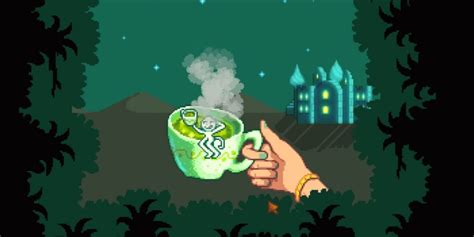
Vibes are everywhere these days. Dark Academia fashion. Cottagecore decoration trends. The ambience of ASMR videos. The cozy pixel aesthetics and game play of Stardew Valley.
But what are vibes really? How can we describe them and what do they mean to audiences?
In a Reddit thread on vibing, users mention the town of Kiki’s Delivery Service as a vibe, the beautiful cities in Stray and Arnold’s cute attic room in Hey! Arnold.
Vibes can be hard to define. In the narrow sense, we can mean that things share a certain tonality or mood or intertext. For example, Batman The Caped Crusader might have film noir vibes and Elden Ring might have Castlevania vibes. I describe these stylistic resemblances as surface vibes.
When we refer to vibes on a visceral level, we often mean a type of affect. We are swept away by a product, a style, an experience. A vibe is a feeling, and more specifically a sense of connection. It’s more than just an aesthetic that’s on display. This is a vibe that is about us. You can’t have a vibe without audience, the human subjects, the ones that are vibing. In The VIM Blog, Zach Biondi writes:
‘Vibes make us feel a certain way. They have an energy that we like or don’t. We are surrounded by them. We are informed by them.’
Vibes, in other words, are about feeling.
Affect and Vibes
A vibe is a set of affective experiences. InThe Autonomy of Affect, Philosopher Brian Massumi often describes affect in relation to intensity: ‘Intensity is embodied in purely autonomic reactions most directly manifested in the skin – at the surface of the body, at its interface with things.’ This intensity reminds me of vibes, and the embodied response that we often have to them.
A vibe is deeply connected to the human subject and their disposition. Zach Briondi writes: ‘One not only has vibes, but one can vibe. Vibing is an activity. I can contribute to the vibes. I give and get vibes.’ Vibes require agency. They are a form of reception – an affective response to a media product.
Vibe do not necessarily have to be positive, even though we often use the term in that context today. Something can obviously send out a bad vibe as well, that is off-putting, creepy or undesirable. Just like any form of affect, it’s neither good or bad. It’s intensity, unqualified. The minute that we qualify it more, and start to reflect on it, affect becomes an emotion.
A vibe is affective in nature. Ideally, I feel it in my whole body. It’s an atmosphere that captures me, that I get immersed in. When I “vibed” to the wedding scene in Beetlejuice, Beetlejuice, I was fully captured by the dancing, the dripping cake and the 1970s music (MacArthur Park by Richard Harris). I tapped my fingers, hummed along, and was moved by the sequence of the shots. It didn’t matter that the story was inconsistent. I enjoyed this scene, this idea, this vibe.
In the iconic essay What My Fingers Knew, cinema scholar Vivian Sobchack writes: ‘That is, we do not experience any movie only through our eyes. We see and comprehend and feel films with our entire bodily being, informed by the full history and carnal knowledge of our acculturated sensorium.’
We have always connected to film with our whole being – our brain, our emotions, our body. When we vibe, we feel it all.

Reproducing Vibes
We live in an age of vibes. The fast adoption of generative AI has only amplified this. Tools such as Midjourney and Stable Diffusion have made it easy to reproduce vibes, especially in the narrow sense. Neural networks draw from existing databases, allowing us to reproduce known styles and tropes. A Star Wars film in the style of Wes Anderson. A female superhero drawn by Warhole. In our prompts we already relate to what we know, and to databases, reproducing specific similarities, specific styles and aesthetic tropes. Vibes.
In an essay on AI images, Roland Meyer points to their archival nature, remixing data that already exists. These images infinitely repurpose specific vibes:
‘A concept such as ‘style’, broadly understood as a nameable and repeatable form of visual aesthetics, a ‘vibe’, ‘mood’, or ‘look’ is now becoming an algorithmically exploitable resource capable of generating infinite variants of new images. As a pattern that can be extracted from large aggregations of digitally mobilized visual content, and thus detached from the individual image, its author, its medium, and its conditions of production, ‘style’ becomes a source of value.’
Perhaps we should be worried. In this time of automation, there is less (human) innovation and more repetition. Audiences search for the specific vibes that they already know and even reproduce them with generative nteworks.
Peli Grietzer also theorizes AI in relation to vibes, albeit in a different way than Meyer. In his theory of vibes in Glass Bead, Grietzer describes a vibe as an‘aesthetic unit’. They require “vibe-insight” though from both humans and neural networks. Grietzer calls this ‘style perception’ or ‘vibe perception’.
Vibe insight is increasingly important today. It’s about spotting references and aesthetics, and also understanding what makes them unique or similar to other products. Vibe insight is a brand of critical media literacy as well. For example, it might be an essential literacy in spotting generative art. The best AI art – with decent fingers and proportions – might only be spotted through its vibes. These are such a blend of similar styles – manga meets Disney princesses, Frozen aesthetics meet BTS -that users can poke through them. In an age of deep fakes and generative imagery, spotting these AI vibes is essential.
The Era of Vibes
Welcome to the age of vibes – an era of repetitions and styles. This is not just the result of automation and an increasingly algorithmic way of thinking. Vibes are everywhere, from legacy sequels to nostalgic needle drops. We live in an age of references and remixed aesthetics, which I like to categorize as surface vibes. Deep emotions and connections still have a place as well, or what I call deep vibes. We want to be moved by a piece of media. By a scene or idea. A film or game could be considered effective when it reaches this emotional intensity.
Media are often reviewed through lenses such as storytelling and character development. A film like Beetlejuice, Beetlejuice might be called sub-par to its original, because it has little story consistency and too many sub plots. Perhaps it also doesn’t fully do justice to some of its characters, such as Lydia. However, as a vibe, the film is unique. Its quirky ideas, aesthetics and songs come together to create something unusual, something moving, something creepy. Something that gets under our skin. Like Monica Belluci who staples herself together to the song Tragedy.
Should we not appreciate the vibes of media more than their stories? Many media today contain fantastic ideas, that can be easily shared in the form of bite-sized clips and memes. In long format, however, they do not always have perfect pacing or consistency. Vibes are things that stand out, like the iconic fifth episode of The Acolyte. When vibes truly become deep vibes, they manage to move us with their atmosphere and ideas. Some of those ideas might be repetitive, but it doesn’t matter. Seeing a perfect sequence from The Rings of Power at just the right moment isn’t cheesy, that’s a beautiful. We linger. We are touched.
Perhaps it’s time to take into account these emotional connections – the vibes, rather than the stories- when we critically assess media.
 Nicolle Lamerichs